OpenAI's Jalapeño Chip: What Falling Inference Costs Mean for AI Agency Pricing
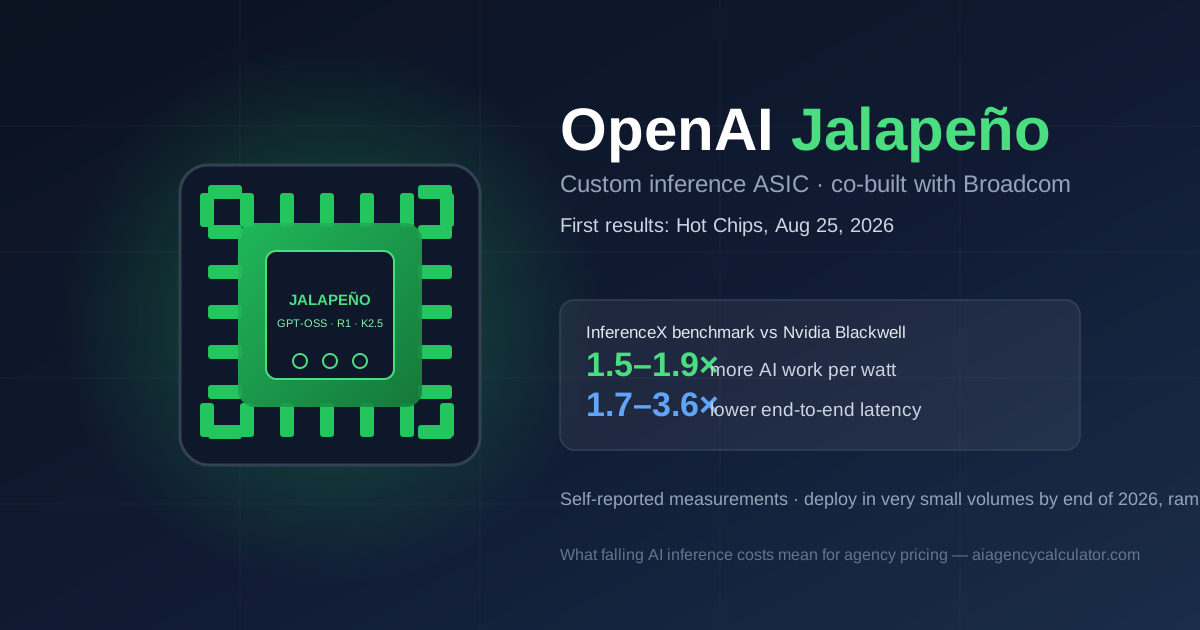
On August 25, 2026, OpenAI published the first measured results for Jalapeño, its custom inference chip — and the numbers are the kind that change AI inference cost conversations. On a public inference benchmark, Jalapeño systems delivered roughly 1.5–1.9× more AI work per watt at peak throughput and 1.7–3.6× lower end-to-end latency than comparison Nvidia Blackwell systems, across three open-weight models.
Will AI API prices keep falling? Short answer for agencies: yes — structurally, but unevenly. Hardware efficiency is improving faster than ever, competition is anchoring the price floor, and OpenAI has now cut prices on the same flagship family twice in one month. But the cuts are increasingly promotional, tier-targeted, and sometimes reversed. What that means for your agency is practical: model cost per token trends down, list prices move in fits, and your pricing calculator needs to track the market quarterly, not annually.
What is OpenAI's Jalapeño chip?
Jalapeño is OpenAI's first custom inference ASIC, co-developed with Broadcom and "purpose-built for the LLM workloads powering ChatGPT, Codex, the API, and future agentic products." It was first reported in October 2025, formally unveiled on June 24, 2026, and published its first results at the Hot Chips conference on August 25, 2026.
The design choices are aimed at inference economics, not raw training speed: it minimizes data movement by placing and keeping the KV cache local, and the network is integral so an entire workload stays within one connected system. It balances compute-bound prefill with memory-bandwidth-bound decode — a combination OpenAI says is a fit for agentic workloads, where a single task can chain many model calls.
Two more facts are worth knowing. First, the chip went from initial design to tape-out in nine months, accelerated by OpenAI's own models; AI-generated kernels ran 1.5–1.8× faster than human-written implementations on selected GPT-OSS attention and MoE blocks. Second, Jalapeño is rated at 700 W but measured sustained power at or below 550 W on tested workloads — against comparison systems rated at 1,200 W (GB200) and 1,400 W (GB300).
What the first results actually show
The benchmark is InferenceX, SemiAnalysis' public benchmark — and the results are OpenAI's own measurements on OpenAI-controlled comparison systems. Treat them as vendor data, not independently audited numbers. That caveat aside, the direction is unambiguous:
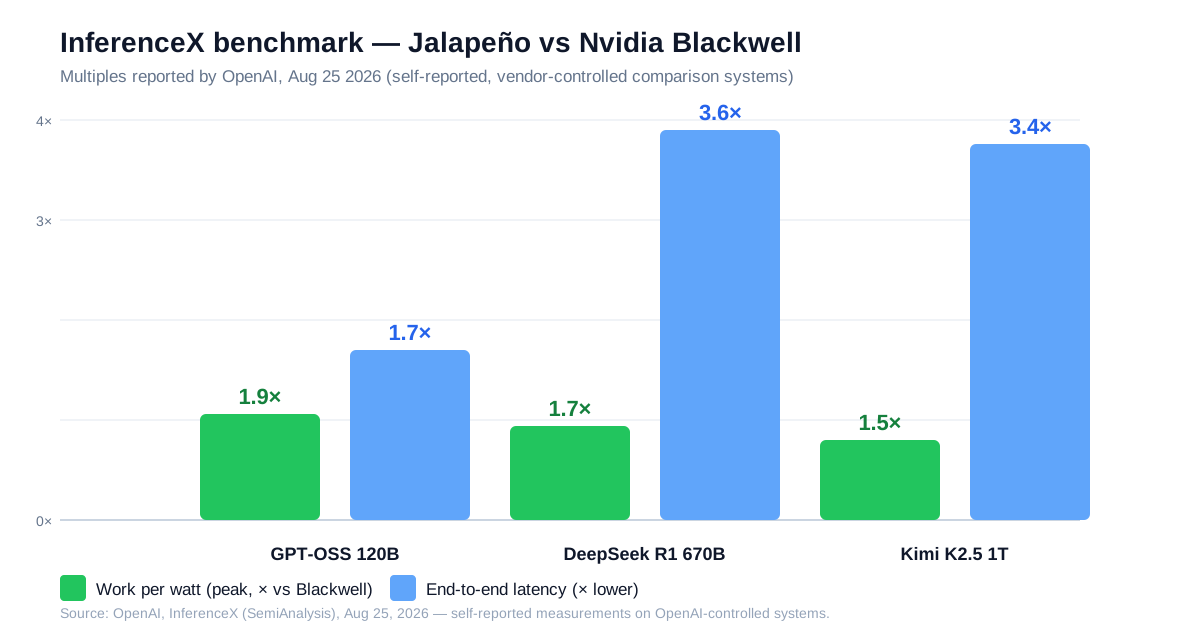
| Model tested | Work per watt (peak, Jalapeño vs comparison) | End-to-end latency | Min time-between-tokens (tok/s/user) | Throughput at previous-best latency |
|---|---|---|---|---|
| GPT-OSS 120B | ≈1.9× (85,448 vs 44,960 mixed TPS/kW) | ≈1.7× lower (1.03 s vs 1.80 s) | ≈2.7× (0.69 vs 1.87 ms) | ≈53.7× (22,935 vs 427 mixed/kW) |
| DeepSeek R1 670B | ≈1.7× (19,641 vs 11,781) | ≈3.6× lower (1.65 s vs 5.99 s) | ≈4.1× (1.43 vs 5.90 ms) | ≈104.3× (12,258 vs 118) |
| Kimi K2.5 1T | ≈1.5× (18,195 vs 11,862) | ≈3.4× lower (1.56 s vs 5.31 s) | ≈3.8× (1.44 vs 5.48 ms) | ≈56.1× (6,744 vs 120) |
Source: OpenAI, InferenceX benchmark (SemiAnalysis), August 25, 2026, self-reported.
The headline is the "throughput at previous-best latency" column. Keeping the same response speed, a Jalapeño system serves tens to over a hundred times more requests per kilowatt than the comparison Blackwell systems — because the comparison systems could only hit that latency target at drastically reduced batch sizes. That is the kind of efficiency that shows up in a provider's cost per successful request.
Why per-watt gains and lower latency matter for inference economics
For agencies, the chip-level details matter only insofar as they change what you pay per token — the AI inference cost your quotes are built on — and they do, through three mechanisms:
Cost per successful result falls. OpenAI frames the gains in exactly these terms: "These gains will help make increasingly capable AI more affordable," and doing more "useful work from the same power and hardware" lowers "the cost of delivering a successful result." More work per watt at the same power envelope means the same hardware serves more customers, which is the structural driver behind cheaper tokens.
Latency changes what you can build. End-to-end latency 1.7–3.6× lower, and time-between-tokens up to ~4× faster, matter most for agentic and real-time workloads — the multi-step chains agencies increasingly sell. Faster time-to-first-token and time-between-tokens also mean shorter user-facing waits, which lets agencies ship interactive products they couldn't reliably deliver before.
The efficiency floor keeps dropping. Inference efficiency is the price floor under the whole market. CloudZero reports OpenAI attributed its July 30 price cut partly to inference work that cut end-to-end serving costs by 20%. Note: that claim predates Jalapeño deployment, so it is not evidence of chip-driven savings yet — it is evidence that OpenAI treats inference efficiency as a pricing lever.
The AI model pricing trend the chip lands in
Jalapeño's first results landed mid-price-war. The timeline tells the story:
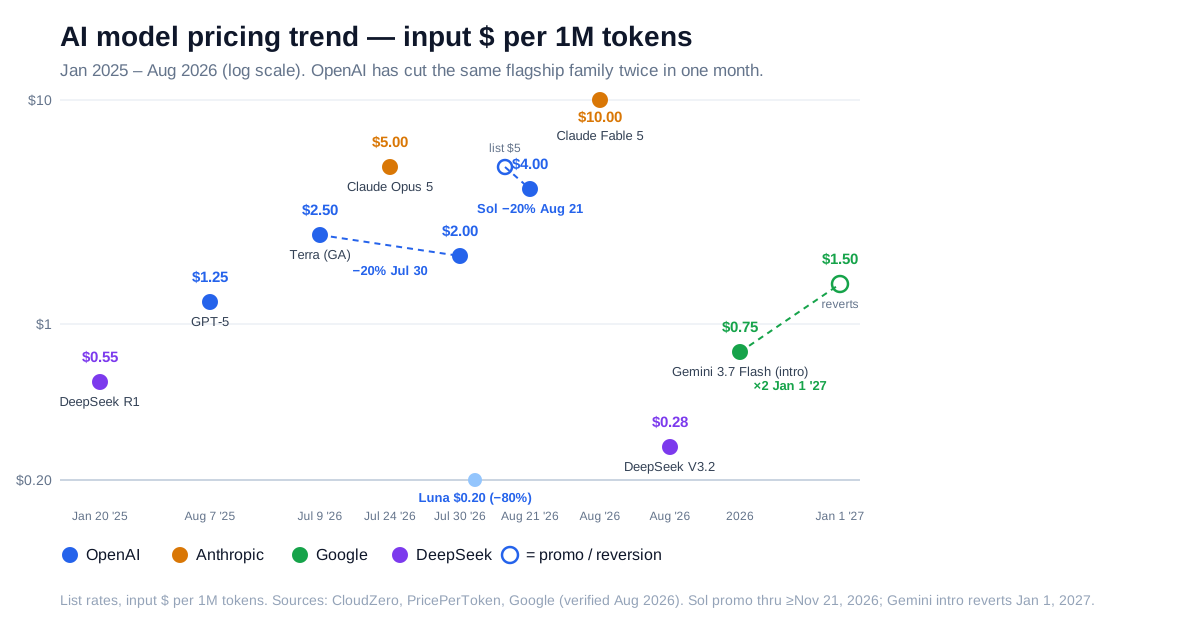
| Date | Event | Model | Input $/M | Output $/M |
|---|---|---|---|---|
| Jan 20, 2025 | DeepSeek R1 launch (price-war trigger) | DeepSeek R1 | $0.55 | $2.19 |
| Aug 7, 2025 | GPT-5 launch | GPT-5 | $1.25 | $10.00 |
| Jul 9, 2026 | GPT-5.6 family GA | Terra | $2.50 | $15.00 |
| Jul 24, 2026 | Claude Opus 5 (current Anthropic flagship) | Opus 5 | $5.00 | $25.00 |
| Jul 30, 2026 | OpenAI cut #1: Terra −20%, Luna −80% | Terra / Luna | $2.00 / $0.20 | $12.00 / $1.20 |
| Aug 21, 2026 | OpenAI cut #2: Sol −20% input / −33% output (promo thru ≥Nov 21) | GPT-5.6 Sol | $4.00 | $20.00 |
| Aug 2026 | Claude Fable 5 (frontier tier) | Fable 5 | $10.00 | $50.00 |
| Aug 2026 | DeepSeek V3.2 | V3.2 | $0.28 | $0.42 |
| 2026 (thru Dec 31) | Gemini 3.7 Flash introductory | 3.7 Flash | $0.75 | $3.75 |
| Jan 1, 2027 | Gemini 3.7 Flash reverts | 3.7 Flash | $1.50 | $7.50 |
Current mid-tier snapshot (Aug 2026): Claude Sonnet 5 $2/$10, GPT-5.6 Terra $2/$12, Gemini 3.1 Pro $2/$12, Claude Haiku 4.5 $1/$5.
Two price cuts on the same flagship family in 22 days — Terra and Luna on July 30, Sol on August 21 — is a pattern, not a promotion. And the chips that make inference cheaper are only beginning to deploy: OpenAI plans "very small volumes" of Jalapeño inside its compute infrastructure by end of 2026, with a more significant ramp in 2027, and Gen 2 and Gen 3 are already on the roadmap. OpenAI says it will keep buying Nvidia and other partners' accelerators for training and inference in the meantime.
Will AI API prices keep falling?
The evidence-backed answer: down, but unevenly. Here is the case for continued declines:
- The cost floor keeps falling. Cerebras' wafer-scale ultrafast tier already serves GPT-5.6 Sol at 14× speed, and Chinese open-weight labs anchor the bottom of the market — DeepSeek V3.2 lists at $0.28/$0.42 per million tokens.
- The chip roadmap targets further per-watt gains. Jalapeño Gen 2 and Gen 3 are on the roadmap, and OpenAI frames each efficiency gain as an affordability gain.
- Competition is structural. Three vendors now sit at the contested $2-per-million-input point for mid-tier models, and the market leader is cutting twice a month.
And the cautionary evidence:
- Cuts are increasingly promotional instruments. Sol's $4/$20 is promotional through at least November 21, 2026, and Gemini 3.7 Flash's intro pricing ($0.75/$3.75) doubles on January 1, 2027.
- Pricing is strategic, not purely cost-driven. On July 30, OpenAI cut where volume lives (Luna −80%, Terra −20%) and held where margin lives (Sol unchanged).
- Cheaper tokens inflate usage. Demand elasticity means your clients' bills can rise while rates fall — the token count goes up faster than the unit price comes down.
Bottom line: structurally, cost per token will keep falling — hardware efficiency and competition both point that way. But list prices will move in fits: promotional, tier-targeted, and sometimes reversed. The OpenAI chip token cost curve depends on more than silicon — pass-through is a business decision for OpenAI, not an engineering certainty; deployment only begins at the end of 2026.
What agencies should pass on to clients
- Model routing is your biggest cost lever. OpenAI's own ladder spans roughly 25× — Sol at $5/$30 (pre-promo list) versus Luna at $0.20/$1.20. Choosing the right tier for the job beats negotiating any single price.
- Output tokens dominate. GPT-5.6 output bills at 6× input across tiers, and the August 21 Sol cut was deeper on output (−33%) than input (−20%) — that's where real savings live. Reasoning tokens billed at output rates can triple effective cost.
- Context assumptions change the math. OpenAI roughly doubles rates past ~272K input tokens, while Claude 4.6+ includes a 1M-token window at standard rates. Long-context workloads need per-provider modeling, not a flat cost-per-1K default.
- Budget promotional reversion. Sol's promo runs through at least Nov 21, 2026; Gemini 3.7 Flash intro pricing doubles Jan 1, 2027. Quote both the promo and the reversion rate so clients aren't surprised by a mid-contract increase.
- Explain the trend, don't hide it. Clients read the same headlines. Position falling token costs as margin you're reinvesting in their scope, and anchor quotes to current verified rates.
Why your calculator's cost assumptions need to change
If your pricing calculator — or the one you present to clients — still assumes last quarter's token prices, you are systematically over-quoting or under-forecasting. Three updates matter most:
- Re-baseline quarterly, not annually. The market moved twice in one month in July–August 2026. A yearly refresh is now a rounding error.
- Model the promo window. A calculator that bakes in Sol's $4/$20 as permanent will understate costs by ~25% on output tokens after November 21 — and by 2× on Gemini 3.7 Flash after January 1, 2027.
- Weight output and context correctly. Output-dominated workloads and long-context agent runs are where per-provider differences are largest; weighting input tokens only will systematically under-forecast bills.
Re-baseline your token-cost assumptions in under a minute
Open the AI Agent API Cost Calculator →Model monthly agent workload costs against current verified rates — then re-check them quarterly, because 2026 pricing moves that fast.
Use the AI Agent API Cost Calculator to model monthly agent workload costs, or see GPT-5.6 Sol API pricing and the AI model cost per task for 2026 for the current verified rates. For the broader pricing-model context, AI agency pricing models explained covers how to structure retainers when the underlying cost basis is falling — the DeepSeek V4 price increase is a live example of why you can't assume any single vendor's trajectory, and our OpenAI inference overhead and agency pricing analysis shows how inference-side costs flow into what you quote.
Practical takeaways
- Plan for falling token costs. Hardware efficiency (Jalapeño-class chips, Cerebras, open-weight competition) is a structural price floor under the market. Re-baseline client quotes and calculator defaults quarterly.
- Price the promo, then the reversion. Sol and Gemini 3.7 Flash both revert before 2027; quote both numbers.
- Route models, don't just pick one. A 25× spread between OpenAI tiers, and three vendors at the $2 mid-tier point, make routing the single largest margin lever you control.
- Watch output tokens and context. Output at 6× input, reasoning tokens at output rates, and 272K+ context surcharges are where naive calculators mis-forecast.
- Don't overstate the chip. Jalapeño's results are self-reported, deployment is tiny until 2027, and the 20% serving-cost cut predates it. The trend is real; the chip alone isn't proof yet.
Frequently asked questions
Will AI API prices keep falling?
Structurally yes, but unevenly. Hardware efficiency gains (OpenAI's Jalapeño chip: 1.5–1.9× work per watt; competition from open-weight labs; Cerebras speed tiers) keep pushing the cost floor down, and OpenAI cut prices on the same flagship family twice in one month (Jul 30 and Aug 21, 2026). But cuts are increasingly promotional and tier-targeted: Sol's $4/$20 is a promo through at least Nov 21, 2026, and Gemini 3.7 Flash intro pricing doubles Jan 1, 2027. Plan for falling token costs with periodic reversion risk, not a one-way linear decline.
How does OpenAI's Jalapeño chip lower token costs?
Jalapeño delivers roughly 1.5–1.9× more AI work per watt at peak throughput and 1.7–3.6× lower end-to-end latency than comparison Nvidia Blackwell systems on the InferenceX benchmark (OpenAI's self-reported measurements). More useful work from the same power and hardware lowers the cost of delivering a successful result — the structural driver behind cheaper inference. Deployment starts in "very small volumes" by end of 2026, ramping in 2027.
How much does AI inference cost in 2026?
Mid-tier models cluster around $2 per million input tokens (Claude Sonnet 5 $2/$10, GPT-5.6 Terra $2/$12, Gemini 3.1 Pro $2/$12). The budget end is far lower: DeepSeek V3.2 at $0.28/$0.42 and OpenAI's Luna at $0.20/$1.20. Frontier tiers run higher — GPT-5.6 Sol $4/$20 (promo), Claude Opus 5 $5/$25, Claude Fable 5.1 $10/$50 — with Gemini 3.7 Flash at $0.75/$3.75 intro through 2026.
Which AI model is cheapest per token in 2026?
DeepSeek V3.2 lists at $0.28/$0.42 per million tokens, the lowest verified frontier-class rate in the August 2026 snapshot, with OpenAI's Luna close behind at $0.20/$1.20. Note the caveats: DeepSeek raised peak/off-peak rates in August 2026, and Gemini 3.7 Flash's $0.75/$3.75 intro rate doubles on Jan 1, 2027.
Why did OpenAI cut GPT-5.6 prices twice in a month?
OpenAI cut Terra −20% and Luna −80% on July 30, 2026, then Sol −20% input / −33% output on August 21 (promotional through at least Nov 21). CloudZero attributes part of the July cut to inference efficiency that reduced end-to-end serving costs ~20% (predating Jalapeño deployment). The pattern shows pricing is now strategic — deep cuts where volume lives, promotional holds where margin lives.
How much cheaper is Jalapeño inference than Nvidia?
On OpenAI's self-reported InferenceX results, Jalapeño delivers ~1.5–1.9× more work per watt at peak throughput and 1.7–3.6× lower end-to-end latency than comparison Nvidia Blackwell (GB200/GB300) systems, across GPT-OSS 120B, DeepSeek R1 670B, and Kimi K2.5 1T. These are vendor measurements on OpenAI-controlled systems; independent audit is pending.
Sources
- OpenAI, "Jalapeño's first results show industry-leading speed and efficiency in AI inference" (Aug 25, 2026): openai.com/index/jalapeno-first-results
- TechCrunch, "OpenAI's Jalapeño chip is built for fast inference at scale, benchmarks show" (Aug 25, 2026): techcrunch.com
- DeepLearning.AI Data Points, "Inside Jalapeño, OpenAI's first inference chip" (Jun 24, 2026): deeplearning.ai
- OpenAI on X, deployment plan post (Aug 25, 2026): x.com/OpenAI
- OpenAI on X, Jalapeño unveiling post (Jun 24, 2026): x.com/OpenAI
- CloudZero, "OpenAI API pricing in 2026 after July price cuts": cloudzero.com
- PricePerToken, GPT-5 API pricing 2026: pricepertoken.com
- Creative AI News, "Frontier AI API Prices Dropped" (Aug 21, 2026): creativeainews.com
- Google, "Introducing Gemini 3.7 Flash": blog.google
- PricePerToken, DeepSeek R1 API pricing: pricepertoken.com
Accuracy note: All chip benchmarks (InferenceX, work-per-watt, latency, throughput) are OpenAI's self-reported measurements on OpenAI-controlled comparison systems as of Aug 25, 2026 — vendor data, not independently audited. The 20% serving-cost reduction cited via CloudZero predates Jalapeño deployment and is not chip-driven evidence. Price timeline uses vendor list rates verified Aug 2026; Sol's $4/$20 is promotional through at least Nov 21, 2026, and Gemini 3.7 Flash intro pricing ($0.75/$3.75) reverts to $1.50/$7.50 on Jan 1, 2027. Jalapeño deploys in "very small volumes" by end of 2026 with a significant ramp in 2027. Rates move frequently — re-verify before quoting clients.